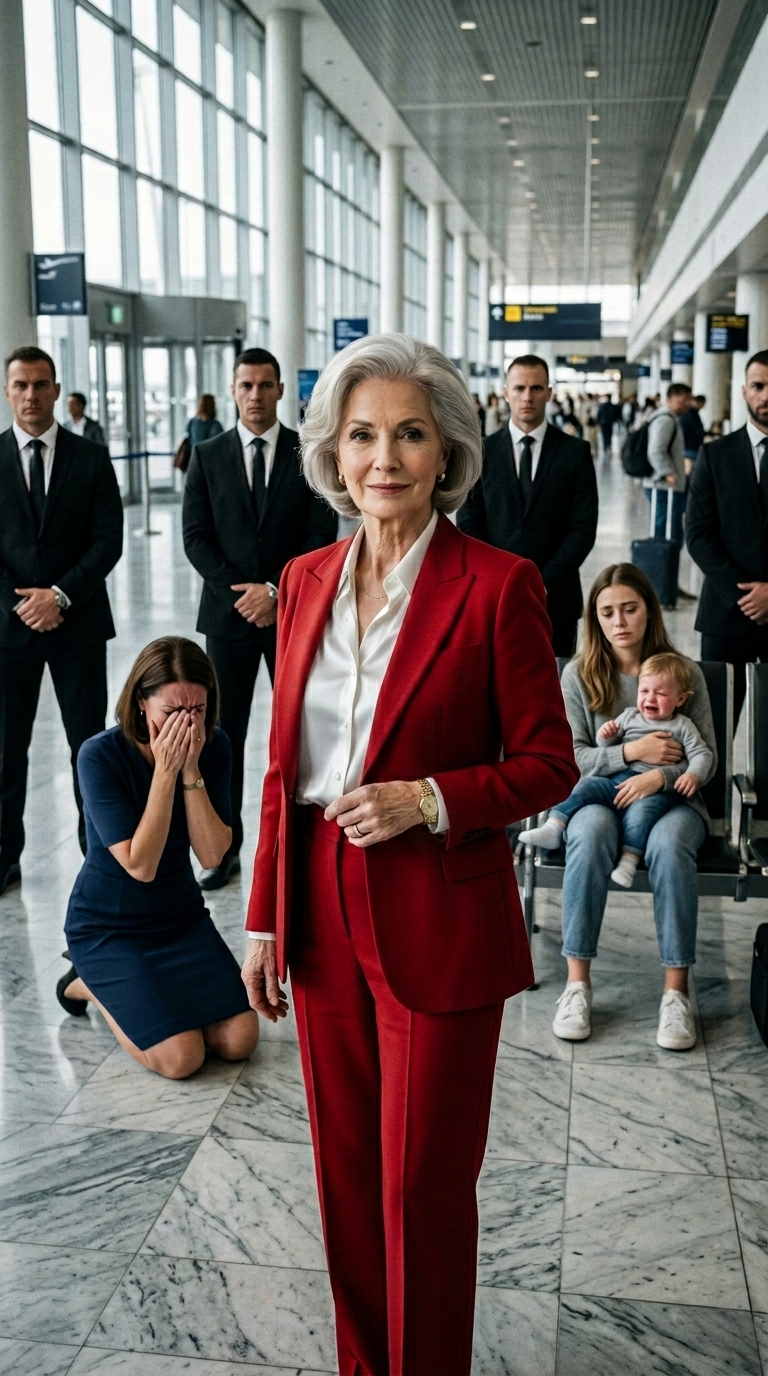
Beatrice stared down at the documents as if they were covered in venomous spiders. Her arrogance collapsed completely, folding in on itself like a dying star.
“Raymond, please!” she shrieked, the mask entirely gone. Tears of pure panic streamed down her meticulously powdered face, ruining her makeup. “You can’t do this! I am your flesh and blood! I’ll lose everything! My status, my memberships… Where am I supposed to go?”
I glanced over my shoulder at Elena. There was no triumph in her beautiful, tired eyes.
There was no thirst for vengeance, no vicious satisfaction. There was only a profound sadness, and a desperate desire for safety. She was a better person than I was.
I turned my attention back to the weeping ruin of my sister.
“You will move into the modest, two-bedroom apartment the foundation owns in downtown Queens,” I dictated, my tone dropping to a cold whisper meant only for her. “And if you ever wish to see a single cent of your stipend restored, you will report every Monday through Friday at six o’clock in the morning to the Caldwell Inner-City Youth Shelter. You will mop the floors. You will serve hot meals to battered women and homeless families who actually comprehend what a genuine struggle is.”
Beatrice gasped, physically recoiling at the word Queens. “I can’t… I don’t know how to do those things!”
“You’re going to learn,” I promised her softly. “You’re going to learn what an actual community looks like.
You’re going to learn, the agonizingly hard way, that a human being’s value is not measured by the exclusivity of their zip code, but by the depths of their kindness.”
Beatrice stared at the eviction papers, then looked past me toward Elena, who was gently rocking Leo to sleep. For the very first time in her pampered, insulated life, Beatrice cried not from a place of thwarted anger, but from the sudden, agonizing realization of her own utter emptiness.
She fell to her knees right there in the doorway, the eviction papers scattering across the floor. I turned my back on her, took Elena by the arm, and led my true family upstairs, leaving my sister surrounded by the deafening silence of her former friends. But the true test of this correction was yet to come.
The immediate aftermath of the exile was a chaotic, humiliating spectacle. True to my word, seventy-two hours later, a team of foundation movers boxed up the east wing.
Beatrice’s designer gowns, her collection of imported shoes, and her antique jewelry were securely locked in climate-controlled storage—collateral against her good behavior. She was permitted to take only what would fit into three standard-sized suitcases. A deliberate, poetic echo of what she had forced upon Elena.
For the first three months, the reports from the shelter in Queens were disastrous.
David Thorne would sit in my study, nursing a scotch, reading the weekly updates from the shelter’s director, a no-nonsense woman named Maria.
“Week one: Beatrice attempted to pay a homeless teenager fifty dollars to mop the cafeteria for her,” David read, adjusting his reading glasses. “Week three: She locked herself in the supply closet and cried for four hours after a resident insulted her haircut. Week six: She requested that the soup kitchen switch to organic, farm-to-table lentils.”
I chuckled darkly, staring out the window toward the guest cottage where Elena and Leo were happily planting a vegetable garden. “Is she giving up, David?”
“That’s the strange part, Raymond,” David replied, closing the file. “She complains bitterly. She cries daily. But she hasn’t missed a single 6:00 AM shift. Not one.”
I kept my distance. I needed the isolation to break her down completely before she could be rebuilt. I ensured Elena and Leo were surrounded by love, security, and the best tutors money could buy. I watched my grandson flourish, his laughter returning to the echoing halls of the manor, slowly filling the unbearable silence Liam’s death had left behind.
Six months into Beatrice’s exile, a bitter December winter hit New York. I decided it was time to inspect my handiwork.
I instructed Arthur to drive me to Queens. We pulled up to the brick facade of the Caldwell Shelter just as the sun was setting. The neighborhood was gritty, loud, and alive—a stark contrast to the sterile manicured lawns of Long Island.
I didn’t announce my arrival. I slipped through the back alley delivery entrance, the smell of industrial bleach and roasting chicken hitting my senses. I pushed open the swinging metal doors of the industrial kitchen and stopped dead in my tracks.
I expected to find a miserable, broken woman staring blankly at a wall. Instead, the sight before me was so profoundly shocking that I actually took a step backward.
Standing over a massive, steaming vat of mashed potatoes was my sister.
She was wearing generic, slip-resistant rubber shoes and baggy, navy-blue scrubs. Her hair, once meticulously styled by a private salon, was tied back in a messy, practical bun secured by a cheap plastic clip. Her face was entirely free of makeup, smeared slightly with flour and sweat.
Beside her stood a little girl, no older than Leo, wearing a ragged coat.
“No, no, sweetie, you have to use your whole shoulder,” Beatrice was saying, her voice lacking any of its former aristocratic shrillness. It was patient. It was warm. Beatrice placed her hand over the little girl’s, guiding the massive metal spoon through the potatoes. “See? Like rowing a boat. You’re doing a brilliant job, Maya.”
The little girl beamed, and incredibly, Beatrice smiled back. It was a genuine, radiant smile—an expression I hadn’t seen on my sister’s face since we were children playing in the mud behind our father’s first, tiny house.
I cleared my throat.
Beatrice looked up. Her eyes widened for a fraction of a second, a flash of her old defensive posture ghosting across her shoulders. But then, she exhaled. She wiped her forehead with the back of her forearm, patted the little girl on the head, and walked over to me.
“You’re late for dinner service, Raymond,” she said, her voice steady. “If you want a plate, you have to get in line like everyone else.”
There was no malice in her tone. Only a quiet, hard-earned dignity.
“You look awful, Bea,” I said softly.
“I feel magnificent,” she replied, looking back at the bustling kitchen, the line of hungry people waiting for warmth. “I know their names, Raymond. All of them. I know their stories. For sixty years, I lived in a mansion surrounded by ghosts. Here… I am actually alive.” She looked down at her battered hands. “I am so deeply sorry for what I did to Elena. To Leo. I was terrified of losing my place in the world, and I tried to destroy a terrified girl to protect my own ego. I understand if you never let me back into the house.”
“Keep stirring the potatoes, Beatrice,” I murmured, a thick lump forming in my throat. “We’ll talk about the house later.”
Five years later.
The Caldwell Family Estate looked, felt, and sounded completely different. The aristocratic ghosts had been permanently exorcised. The extravagant, soulless charity luncheons were a thing of the past.
To the absolute shock of New York high society, when Beatrice’s probationary period ended, she refused to move back into the east wing full-time. She had discovered a profound, sustaining sense of purpose amidst the chaos of the shelter, eventually taking over as its full-time Director of Operations. She used her formidable, bulldog personality not to belittle socialites, but to ruthlessly squeeze donations out of them to fund the shelter’s expansion.
She had earned her way back into our family ecosystem, not as a tyrant wielding a checkbook, but as a humbled, deeply flawed, and healing human being.
It was a crisp Sunday afternoon in October. I sat on the veranda, a cup of black coffee in my hand, watching the leaves turn crimson and gold.
From the open kitchen window, the sweet smell of baking vanilla drifted out, accompanied by the sound of raucous laughter. I stood up and walked to the window, peering inside.
Elena was sitting at the kitchen island, going over her law school textbooks—a dream Liam had always encouraged her to pursue. Beside the oven, covered head-to-toe in a disastrous layer of white flour and chocolate chips, was nine-year-old Leo.
And standing right beside him, wearing a stained apron over her casual sweater, was Aunt Beatrice, showing him exactly how to fold the dough so the cookies would bake perfectly soft in the center.
“More chocolate chips, Auntie Bea!” Leo demanded, laughing.
“A Caldwell never skimps on the chocolate, Leo,” she replied, winking at him and dumping the entire bag into the bowl.
I stepped back from the window, leaning against the cool stone of the manor, and closed my eyes. The grief of losing Liam would never fully evaporate. It was a phantom limb, a permanent ache. But we had survived the devastation of his absence by tearing down the rotting foundations of our arrogance and learning how to fiercely protect what truly mattered.
Power is not the ability to exile those you deem beneath you. True power is the strength to break down a broken system, to humble the arrogant, to elevate the vulnerable, and to build a table large enough for everyone who is willing to do the hard work of loving one another.
We were, finally, a family.
If you want more stories like this, or if you’d like to share your thoughts about what you would have done in my situation, I’d love to hear from you. Your perspective helps these stories reach more people, so don’t be shy about commenting or sharing.
✅ End of story — Part 3 of 3
← Read from Part 1