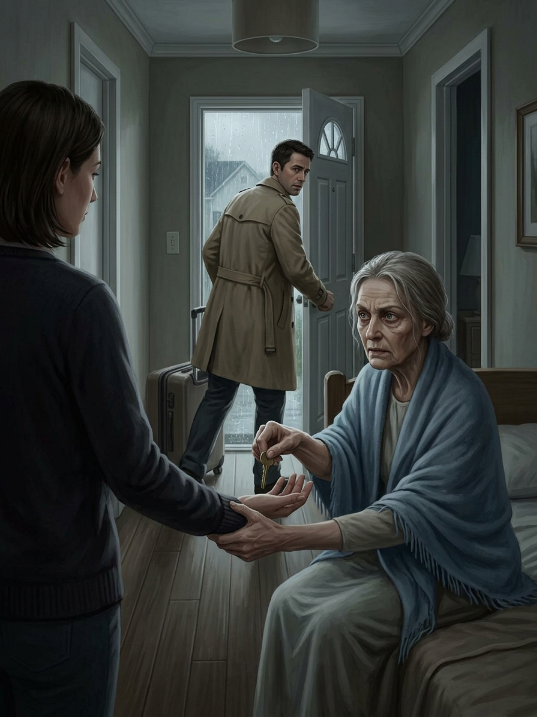
“Sophia—”
“Aruba looks warm.”
He recovered fast. I had to give him that. Michael could build a lie out of smoke and sound wounded that you noticed the air changing.
“It’s not what you think.”
“It never is.”
“Natalie was there with a client group. I couldn’t tell you because of confidentiality.”
I laughed then.
Out loud.
It sounded strange in the dead woman’s house.
“Your mother died in my arms while you were drinking champagne with Natalie on a balcony.”
“You don’t know what I was doing.”
“I know what I was doing. That’s enough.”
His voice lowered.
“Sophia, we need to handle Mom’s arrangements. Don’t touch anything until I get back.”
There it was.
Not grief.
Control.
I looked at the envelope on the counter.
“Come back when you can.”
“I’ll be there tomorrow.”
The line clicked dead.
I stood in the kitchen for a long time after that.
Elizabeth’s room was quiet.
The house smelled of rain and medicine and the ending of something.
By noon, Clara Finch arrived.
She was in her early sixties, small, silver-haired, and dressed in a dark wool coat despite the damp warmth of the afternoon. Her eyes were sharp enough to cut thread. She carried a leather satchel and moved through the house like someone who knew exactly where grief ended and paperwork began.
She did not ask to sit.
She walked straight to Elizabeth’s room, stood in the doorway, and bowed her head.
“Stubborn woman,” she whispered.
Then she turned to me.
“Did she suffer?”
“Not at the end.”
Clara nodded once.
“She liked you.”
I gave a tired, broken smile.
“She had an interesting way of showing it.”
“She trusted very few people. Liking was a luxury. Trust was the real gift.”
I led her to the kitchen and showed her the envelope.
She examined the key but did not touch it at first.
“Michael never found this?”
“No.”
“Then Elizabeth won one more round.”
I sat down because my legs suddenly felt unreliable.
“Please tell me what’s happening.”
Clara pulled out a chair across from me.
“Elizabeth Hartley was born Elizabeth Ward in Blackwell, Pennsylvania. Her family owned a farmhouse, twenty-seven acres, and a small commercial strip downtown. Most of it was supposed to pass to her after her father died. Instead, when her husband became ill and medical bills mounted, she trusted Michael to help manage the paperwork.”
My stomach tightened.
“How long ago?”
“Six years.”
The same year Michael and I got married.
Clara continued.
“He persuaded her to sign documents she did not fully understand. A power of attorney. Account access. Several transfer authorizations. Some legitimate, some questionable, some very much not.
By the time she realized what he had done, money had moved. Property had been leveraged. A safe deposit box was emptied.”
I thought of Michael’s perfect suitcase.
His blank-wall video calls.
His sunlit face.
“What did he take?”
“More than he will admit.”
“How much?”
“Enough to fund an impressive lifestyle for a man who told his wife the card for his mother’s medicine was loaded.”
My eyes burned.
Clara’s expression softened, but only slightly.
“Elizabeth came to me when she started getting collection notices on property taxes for land she believed was already sold. It wasn’t sold. Michael had tried to use it as collateral through a shell company. Badly. He was not as clever as he thought.”
That sounded like Michael.
Confident enough to be dangerous.
Careless enough to leave tracks.
“Why didn’t she go to the police?”
“She wanted to. Then she got sick. Then Michael promised to fix it. Then he moved her into your house.”
I whispered, “To keep her quiet.”
Clara nodded.
“And to keep her dependent. But he underestimated her memory. Elizabeth hid the originals before he could get them.”
“Under the pickle jar.”
“The ceramic crock,” Clara corrected softly. “Her mother’s. She told me once that no Hartley man ever looked under anything used for women’s work. They opened desks, safes, toolboxes. Never the kitchen.”
I almost smiled.
Then the tears came.
Clara let them.
When I could breathe again, she said, “We need to go to Blackwell tomorrow morning.”
“Michael comes back tomorrow.”
“Then we go before he lands.”
“What is under that crock?”
Clara looked at the brass key.
“The beginning.”
Blackwell was four hours away.
Clara drove because she said grief and betrayal made poor companions on mountain roads. I sat in the passenger seat with Elizabeth’s envelope in my lap and watched suburbs turn into bare trees, old mills, gas stations, and small towns with church steeples and cracked sidewalks. Rain followed us halfway, then thinned into mist.
We reached Blackwell just after noon.
It was the kind of town people leave and then spend the rest of their lives pretending they have outgrown. Brick storefronts. A diner with fogged windows. A hardware store sign faded by sun. A courthouse square with a war memorial and three benches no one had repainted in years.
The old Hartley house stood at the edge of town, behind a rusted iron gate and a line of overgrown hedges.
White farmhouse.
Green shutters.
Sagging porch.
A maple tree in the yard that must have been enormous in summer.
It looked abandoned but not dead.
Clara parked near the gate.
I got out slowly.
The air smelled of wet leaves and chimney smoke. Somewhere nearby, a dog barked twice and stopped.
“The utilities are off,” Clara said, pulling a flashlight from her satchel. “But the structure is safe enough. I had an inspector out two years ago.”
“You’ve been here?”
“Elizabeth asked me to check it after she realized Michael was circling back.”
I looked at the house.
“He knew about it?”
“He knew pieces. He thought the important things were gone.”
Because that’s where he thinks it ends.
And that’s where it starts for you.
The brass key fit the back door.
It turned with a stubborn little click.
Inside, the house smelled like dust, cold wood, old wallpaper, and time. Sheets covered furniture in the parlor. The hallway floor creaked under our steps. A calendar from eight years earlier hung crooked near the pantry. The air was still enough to feel held.
The kitchen was at the back.
The moment I stepped inside, I understood why Elizabeth had sent me there.
It did not look like a room where secrets should be hidden.
It looked like work.
A wide farmhouse sink.
Blue cabinets faded at the edges.
A scarred wooden table.
A cast-iron stove.
Shelves lined with old jars.
And in the far corner near the pantry, a big ceramic crock with blue flowers painted around the rim.
The pickle jar.
It was heavier than it looked. Clara and I moved it together, scraping dust from the floor beneath it. Underneath was a square of linoleum different from the rest, carefully cut and fitted back into place.
My hands began to shake.
Clara handed me a small pry tool.
“You do it.”
I knelt.
The linoleum lifted with a dry crack.
Beneath it was wood.
One board had a small brass keyhole set deep into the grain.
I looked at Clara.
She nodded.
The key Elizabeth had pressed into my palm one year earlier slid in perfectly.
Turned.
Released.
The board lifted.
Below was a metal box wrapped in oilcloth.
For a second, neither of us moved.
Then I reached down and pulled it out.
It was heavier than I expected.
Not treasure-heavy.
History-heavy.
Clara cleared the kitchen table while I unwrapped it. The box was black metal, scratched at the corners, with another small lock. The same key opened it.
Inside were envelopes.
Not one.
Dozens.
Each labeled in Elizabeth’s careful handwriting.
Original deed — Hartley farmhouse.
Commercial property — Blackwell Main Street.
Bank records.
Michael transfers.
Sophia.
My breath caught.
I touched the envelope with my name on it.
Clara leaned closer.
“That one first.”
Inside was a letter.
Dear Sophia,
If you are reading this, then I am gone, and my son has done what I feared he would do: left you to carry what he owed.
I was not kind to you when you married Michael. I saw you as too soft, too hopeful, too willing to believe a man because you loved him. It frightened me because I had once been that woman.
Then I became cruel, which is not the same as wise.
You cared for me when my own son abandoned me. You washed my hair. You changed my sheets. You paid for medicine when the card failed. You called me Mom once when the fever took me, then apologized for it. You should not have apologized.
You were more my daughter in the last year than Michael was my son.
He thinks everything valuable is already in his hands.
He is wrong.
The farmhouse is mine. The Main Street properties are mine. The mineral lease payments he never found are mine. The account he thought he emptied was not the real account.
And because blood without honor is only biology, I have left control where care actually lived.
To you.
Do not let him charm you.
Do not let him frighten you.
Do not let him call your decency weakness.
Start in the kitchen. Women always know where things are buried.
Elizabeth
I could not read the last line twice.
The words blurred.
Clara reached into the box and removed another folder.
“Her revised will,” she said quietly. “Executed eighteen months ago. Recorded with my office. Copies secured. This is the original.”
I looked up.
“She left me the house?”
Clara’s eyes held mine.
“She left you the farmhouse, the commercial strip, the protected investment account, and whatever recovery we can obtain from Michael’s unauthorized transfers.”
My mouth went dry.
“I don’t understand.”
“That’s because you are thinking like a wife who has been given grocery money.” Clara slid a document toward me. “You need to start thinking like the executor of Elizabeth Hartley’s estate.”
The kitchen seemed to sway.
I gripped the table.
“How much?”
Clara opened another folder.
“Conservatively, including property value and accounts Michael never reached? Just under two million.”
The room went silent.
Two million.
I thought of the card declining at the pharmacy.
The nights I ate toast for dinner because Elizabeth needed the better food.
Michael drinking wine in Aruba.
Natalie smiling on a balcony.
Elizabeth watching me from her bed, noticing everything.
My life changed in that moment, but not the way people think money changes a life.
I did not feel rich.
I felt seen.
That was more dangerous.
We spent three hours at the farmhouse.
Clara photographed every document before moving anything. The box contained the original will, deeds, bank statements, copies of letters Elizabeth had sent Michael, screenshots of his replies, receipts showing money moved from her accounts into companies tied to him, and one notarized affidavit Elizabeth had signed six months earlier.
In it, she stated plainly that Michael had misrepresented documents, pressured her while she was ill, diverted funds meant for her care, and abandoned her in my care while falsely claiming to be working overseas.
She included dates.
Amounts.
Account numbers.
Even printed photos.
Aruba.
Natalie.
Michael had been sloppy because he believed the women around him were too exhausted to check.
Elizabeth had checked.
Then hidden the proof under a pickle crock.
By the time we left Blackwell, Clara had the metal box in her trunk and I had Elizabeth’s letter pressed against my chest inside my coat.
Michael was waiting at my house when we returned.
His rental car sat crooked in the driveway. He stood on the porch with his phone in one hand, looking furious in a black coat and expensive shoes entirely wrong for the rain. Natalie was not with him.
Of course she wasn’t.
Men like Michael bring mistresses to balconies, not consequences.
The moment I stepped out of Clara’s car, he came down the steps.
“Where the hell have you been?”
Clara got out before I could answer.
Michael stopped.
He recognized her.
That told me enough.
“Mrs. Finch,” he said, voice changing instantly. Smoother. Warmer. More cautious. “I didn’t know you were involved.”
Clara closed her car door.
“That is generally why surprises work, Michael.”
His jaw tightened.
He looked at me.
“Sophia, we need to talk privately.”
“No,” I said.
One word.
Simple.
New.
His eyes narrowed.
“My mother just died.”
“I know. I was there.”
That hit him. I saw it.
Not grief.
Shame trying to find a hiding place.
“I was trying to get back.”
“From Aruba?”
Color rose in his neck.
“We are not doing that now.”
“Yes,” I said. “We are.”
He stepped closer.
Clara’s voice cut in.
“Take one more step toward her aggressively, and I will call the police before you finish inhaling.”
Michael turned on her.
“You don’t scare me.”
“No,” Clara said. “Documents do.”
He went still.
I watched the word enter him.
Documents.
His eyes flicked toward her satchel.
Then toward me.
“What did she give you?”
I almost admired how quickly he understood his mother had left a knife somewhere.
“Truth,” I said.
His face hardened.