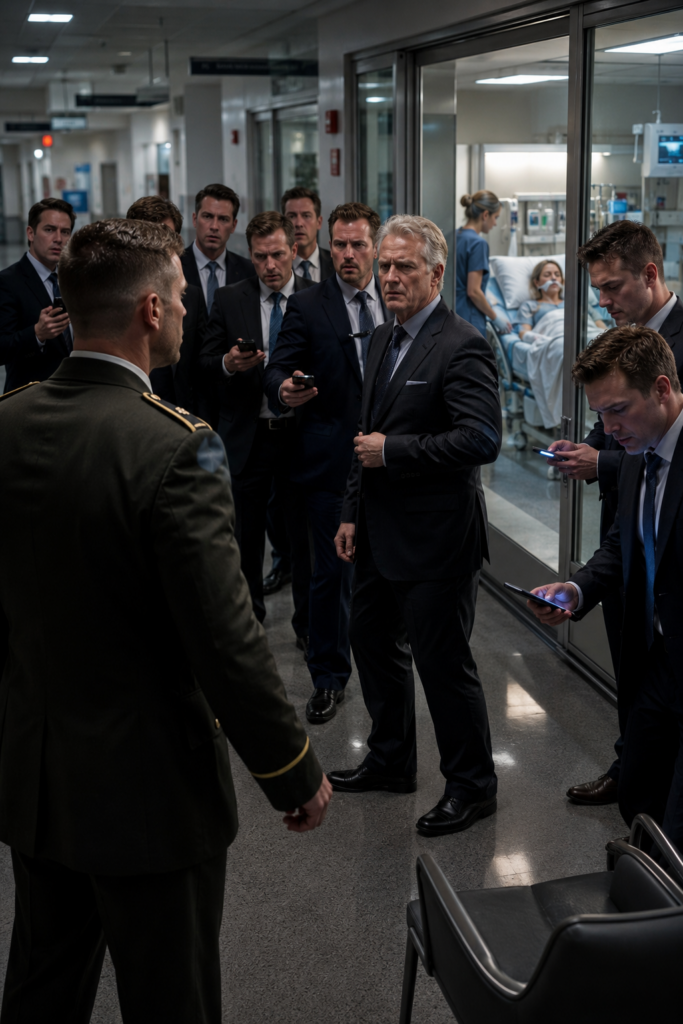
“He was ours,” I said.
Her lips trembled. “I tried to get away.”
“I know.”
“I called for you.”
“I know.”
“I’m sorry.”
“No.” My voice broke for the first time. “No, Tessa. You do not apologize for surviving.”
Her eyes searched mine. “Are they still out there?”
I looked toward the glass. Reaper and Viper stood in the hallway, one on each side of the door. Beyond them, two federal agents remained posted.
“No,” I said. “They’re gone.”
“Gone where?”
“Custody.”
She stared at me, trying to understand through medication and pain.
“All of them?”
“All of them.”
“Did you do it alone?”
I looked at my men outside the door.
“No,” I said softly. “I never go in alone. Not anymore.”
A few hours later, Agent Dane came to take Tessa’s statement, gently and in pieces.
I stayed only because Tessa asked me to. Her voice was weak, but clear. She told the truth without embellishment. The documents. The threats. The nursery bag. Caleb blocking the door. Silas telling her she had forgotten who owned the Sterling name.
When she finished, Agent Dane closed her notebook.
“You were very brave,” she said.
Tessa turned her face toward the window. “I was very stupid.”
“No,” Agent Dane said, not unkindly. “You were outnumbered.”
After she left, Tessa slept.
I stood by the window and watched Boston move below. Traffic, ambulances, people crossing streets with coffee cups, a city continuing because cities always do. Behind me, my wife breathed. Somewhere in federal holding, nine Sterling men sat stripped of suits, titles, and power. I expected satisfaction.
Instead, I felt hollow.
Justice, when it begins, does not resurrect what was taken. It only prevents the thieves from continuing to walk around with full pockets.
That evening, a nervous young nurse approached me with a sealed manila envelope.
“Captain Thorne?”
“Yes.”
“This was delivered by Agent Dane. She said it was recovered during the search of the Sterling estate. She thought your wife should have it eventually, but…” She glanced at Tessa sleeping. “Maybe you first.”
I thanked her and waited until she left.
Inside the envelope was a handwritten letter.
The paper was old, folded twice, worn at the edges. The handwriting was elegant but uneven, as if written by someone whose hand shook while her mind fought to remain precise.
Elizabeth Sterling.
Tessa’s mother.
She had supposedly died of a sudden heart defect when Tessa was eight years old. That was the official story. A tragedy. A genetic weakness. A private family sorrow that Silas spoke of with dignified sadness when donors were listening.
The letter told another story.
It described years of control. Fear. Isolation. Silas deciding what she wore, whom she saw, what doctors she could trust, what friends disappeared after questioning him.
It described the brothers, then boys, learning cruelty by imitation. It described a house where staff knew not to hear certain things and doctors signed what they were paid to sign. It described Elizabeth’s certainty that if anything happened to her, it would not be an accident.
My hands tightened on the paper.
The final line made the room tilt.
I cannot fight them anymore. I only pray that one day, someone strong enough comes into this family and protects my little girl.
I folded the letter carefully and placed it inside my jacket, over my heart.
I was not only the man who survived the Sterlings.
I was the man who ended them.
But ending them did not heal Tessa.
That took time.
The public collapse moved faster than her body could. News vans camped outside the hospital. Reporters shouted questions I refused to answer. Sterling board members resigned. Donors removed names from websites. Federal prosecutors announced charges. Civil suits appeared. Former employees and servants came forward with stories that confirmed what the powerful had buried for years.
Silas and his sons were denied bail after prosecutors argued they posed flight risks and had access to hidden assets. The video evidence remained sealed at first, then portions were described in court filings. The financial crimes alone could have buried them. The assault and conspiracy charges made sure the public understood the rot had not been abstract.
Still, none of that mattered when Tessa woke screaming from nightmares.
None of it mattered when she tried to stand and collapsed from pain. None of it mattered when she touched her stomach and forgot for half a second, then remembered. None of it mattered when she refused to look at the nursery videos on her phone because every recording before the attack contained hope she could not bear to hear.
I resigned four months later.
Not because the military asked me to. They would have kept me. Men like me are useful. Men like me always have another mission, another deployment, another problem that requires quiet hands and clear eyes. But one morning I stood outside Tessa’s rehabilitation room watching her take three steps between parallel bars while tears ran down her face, and I understood that the old war no longer had a claim stronger than this one.
She looked up and saw me.
“I hate them,” she said.
“I know.”
“No.” Her arms shook on the bars. “I hate that I loved them.”
That was the wound beneath the wound.
So I resigned. Reaper followed three weeks later. Viper pretended he was considering options, then appeared at my door with two duffel bags and said, “Civilian life is loud and badly organized.” He never officially asked to stay. He simply did.
We moved three thousand miles away to the forests of the Pacific Northwest.
From the outside, our new home looked like a quiet timber cabin tucked among pines, with a gravel driveway, a metal roof, and smoke curling from the chimney in winter. In truth, it was a sanctuary built by men who had spent their adult lives assuming danger was only sleeping. Thermal cameras watched the tree line. Encrypted communications ran through a secure room beneath the garage. Reinforced doors. Independent power. Medical supplies. Quiet redundancies everywhere.
Tessa called it paranoid.
Then she called it peaceful.
The first time snow fell there, she stood on the porch wrapped in a blanket, watching white gather on the railing.
“It’s so quiet,” she whispered.
“It usually is,” I said, standing beside her. “Right before the storm.”
She gave me a tired smile. “That was not comforting.”
“I’m working on comforting.”
“You are terrible at it.”
“I know.”
She leaned into me anyway.
In the back garden, beneath an old oak tree that had somehow taken root in soil that should have belonged only to pines, we built a small memorial for our son. A flat river stone engraved only with the name we chose after weeks of silence.
Samuel.
Tessa had wanted it because it meant God has heard. I wanted it because saying his name made him less like a wound and more like a child we had loved.
Wildflowers grew around the stone in spring. Some days Tessa sat there for hours. Some days she could not look at it. I learned not to guide grief unless she reached for my hand.
Reaper lived in a converted guesthouse and turned half of it into a communications center that made federal field offices look underfunded. Viper occupied the loft over the detached garage and installed security upgrades the manufacturer would not have recognized. We became, to the nearest town, three retired military men and one quiet woman recovering from a family tragedy. People were kind. They brought soup. They asked few questions. That alone made them better than many rich men I had known.
But peace did not erase purpose.
It sharpened it.
The Sterling case drew messages. At first, they came through official channels. Then private ones. A woman in Chicago trapped by a politically connected husband. A whistleblower in Dallas whose employer had police on payroll. A college student in Virginia whose family name protected men who hurt people in private homes and smiled at fundraisers. People heard what happened to the Sterlings and began whispering into the dark, hoping something in it would answer.
I ignored the first messages.
Tessa did not.
One evening, six months after we moved, I found her in the secure room reading a file Reaper had flagged.
“You shouldn’t be down here,” I said.
She did not look away from the screen. “Because I’m fragile?”
“Because this is ugly.”
She turned then. Her hair was shorter now, cut at her shoulders, and a thin scar near her temple caught the light. She was still healing. Her body moved carefully, but her eyes had changed. Not hardened exactly. Clarified.
“My whole life was ugly behind expensive doors,” she said. “I survived it because people looked away.”
I said nothing.
She tapped the screen. “This woman’s husband is a state senator. Her family says she’s exaggerating. Police keep losing reports. Does that sound familiar?”
“Tessa.”
“No.” Her voice shook, but she did not stop. “You told me once you were what gets sent when everything else fails.”
“I said that to frighten your father.”
“Good. It worked. Now mean it.”
I looked at the file. Surveillance photos. Financial records. Hospital reports. A pattern hidden under influence.
“This is not a war we can fight casually,” I said.
“Then don’t fight casually.”
Behind me, Reaper spoke from the doorway. “For the record, I already mapped the senator’s donor network.”
Viper appeared behind him, holding coffee. “And his security detail is lazy.”
I stared at them.
Reaper shrugged. “We were bored.”
Tessa stood slowly and crossed the room to me. She placed one hand over my chest, where I had once carried her mother’s letter.
“I don’t want revenge forever,” she said. “But I do want the world to have fewer rooms like the one I was trapped in.”
That was the beginning of Thorne Response Group, though we did not call it that for nearly a year.
Officially, we became a private security and investigative consultancy specializing in high-risk witness protection, corruption documentation, and crisis extraction. Unofficially, we became a door that opened for people powerful men believed had none. We worked with attorneys, federal contacts, journalists, auditors, and occasionally law enforcement officials who still remembered why they took the oath. We did not operate outside the law. We operated in the places where cowards had allowed the law to be buried and dug until it could breathe again.
We were not vigilantes.
That mattered to me.
Vengeance is a fire that always asks for more fuel. Justice is slower. More frustrating. More disciplined. It requires evidence, chain of custody, witness protection, timing, patience, and the humility to let courts do what your anger wants to do faster.
I had enough anger to burn cities.
Tessa taught me to build instead.
The Chicago case broke open in forty-three days. The senator resigned within two months. His wife entered protective housing with her children and later testified before a grand jury. Reaper called it “the pilot program.” Viper called it “messy but acceptable.” Tessa cried when the woman sent a handwritten thank-you note with a child’s drawing tucked inside.
I placed the drawing beside Samuel’s memorial for one day, then sent it back because Tessa said a child’s hope belonged with its mother.
Cases followed. Not constantly. We chose carefully. We refused anything that smelled like revenge without evidence. We turned away people who wanted us to punish ex-spouses, ruin business rivals, or frighten someone who had embarrassed them. Power attracts both victims and liars. Learning the difference became our real work.
Years passed that way.
The Sterling trials unfolded in the background of our new life. Silas was convicted on conspiracy, obstruction, bribery, and financial charges before the assault case fully reached verdict. Caleb took a plea and testified. Peter testified too, crying through most of it. The others fell in pieces, blaming one another until the jury saw exactly what kind of family they were. Silas died in federal custody six years later, still appealing, still insisting the world had misunderstood him.
Tessa did not attend the funeral.
She did visit her mother’s grave once.
I went with her. Reaper and Viper stayed at a distance. The Sterling plot was surrounded by ironwork and old stone angels, all of it too grand for the truth buried there. Tessa placed wildflowers on Elizabeth’s grave, the same kind that grew around Samuel’s stone.
“I’m sorry,” she whispered.
For a moment, I thought she was speaking to her mother.
Then she said, “I kept trying to make them love me after you died. I thought if I became perfect, they would stop being cruel.”
The wind moved through the cemetery.
Tessa wiped her face. “I know now. They were cruel because they were cruel. Not because I failed.”
I stood beside her, saying nothing because nothing needed saying.
On the flight home, she slept with her head against my shoulder.
I looked out at the clouds and thought of the first call from Massachusetts General. Survived, the nurse had said. At the time, survival had sounded like a mercy too small for the loss it carried. Now I understood survival differently. It was not the end of suffering. It was the beginning of choice.
Tessa had survived.
Then she had chosen what to build from the ruins.
One autumn evening, nearly seven years after the night that changed everything, I stood on the porch of our cabin drinking black coffee while the sun sank behind the pines. The air smelled of rain and woodsmoke. Down in the garden, wildflowers bent around Samuel’s stone. Reaper was in the guesthouse arguing with someone in three languages over encrypted channels. Viper was repairing a motion sensor he had installed so perfectly that only he could detect its failure. Tessa was inside baking bread badly and refusing to admit it.
I no longer wore a uniform.
But I was still on duty.
The encrypted phone on the porch table vibrated.
Not Department of Defense. Not old command. Not the life I left behind.
A new coordinate.
A new case.
I opened the file.
A powerful family in California wine country. A daughter-in-law trapped behind conservatorship threats. A husband being destroyed through fabricated psychiatric records. Local police unwilling to touch the family because the family practically owned the county hospital.
I read the summary once.
Then again.
The old ice returned to my blood, but it no longer owned me. It had become a tool. Cold enough to steady the hand, not freeze the heart.
Tessa stepped onto the porch behind me. I knew her footsteps now in every condition. Tired, angry, happy, hurting, barefoot, booted, cautious, strong.
“Another one?” she asked.
“Yes.”
“Bad?”
“Yes.”
She came beside me and looked at the screen. Her face tightened, not with fear. Recognition.
For a long time, neither of us spoke.
Then she handed me my black tactical jacket from the hook beside the door.
“Go,” she said softly. “Show them.”
Heavy tires crunched on the gravel driveway.
A black armored SUV rolled into view through the fading light. Reaper drove. Viper sat in the passenger seat, already reviewing the dossier. They both looked exactly as they had years earlier in the hospital corridor and nothing like those men at all. Older now. Scarred in different ways. Still ready.
I looked at Tessa.
“You sure?”
She touched my face. “I don’t need you to fight every monster.”
“I know.”
“But when you do,” she said, “bring them into the light.”
I kissed her.
Then I walked down the porch steps toward the waiting vehicle.
Inside, the dossier sat on the rear seat. Surveillance photos. Financial records. Flight logs. Medical signatures. Names. Dates. Patterns. A powerful man who believed money and political connections made him untouchable.
He had no idea the dark was already on its way.
I opened the SUV door and looked back once.
Tessa stood on the porch beneath the warm light, no longer the broken woman in Room 412, no longer the daughter begging a family to become human, no longer a prisoner of the Sterling name. She was my wife. My witness. My reason. The strongest person I knew.
Reaper glanced at me through the rearview mirror. “Captain?”
I smiled faintly. “You know I’m retired.”
“Old habits.”
Viper looked back from the front seat. “Target packet is ugly.”
“They usually are.”
“Local law compromised.”
“They usually are.”
“Family thinks they’re untouchable.”
I closed the door.
“They always do.”
The SUV rolled down the driveway into the pine-shadowed road. Behind us, the cabin lights faded. Ahead, darkness gathered over the mountains.
I picked up the encrypted phone and spoke into the channel.
“We’re coming.”
Reaper smiled.
Viper checked his weaponless kit, all cameras, drives, credentials, legal packets, and quiet tools built for truth rather than blood.
“And we never come alone,” I said.
The road curved into the night.
Somewhere far away, another powerful man was sleeping peacefully, certain the world would protect him because it always had.
By morning, he would learn what Silas Sterling learned too late.
Consequences do not need permission.
They only need a way in.
THE END
✅ End of story — Part 3 of 3
← Read from Part 1