They never came.
Later that night, in the hotel suite overlooking the harbor, the silence finally caught up with me. My phone sat on the nightstand, a black brick of rejection. No missed calls. No “Congratulations.” No “We’re sorry.”
David found me standing by the window, staring at the silhouette of the USS Wisconsin. He wrapped his arms around me from behind.
“You don’t have to keep waiting, Nola,” he said, his voice vibrating against my back. “Family isn’t the people who are supposed to show up. It’s the people who do.”
I turned and buried my face in his chest. But later, when his breathing was deep and even, I slipped into the cold marble bathroom, turned on the shower to mask the sound, and slid down the wall. I pressed my fist into my mouth and sobbed until I dry-heaved. It was the ugly, silent crying that tears you apart from the inside.
The sun rose the next morning, mocking me with its cheerfulness. We were on the balcony, sipping coffee we couldn’t taste, trying to salvage a honeymoon from the wreckage.
Then, my phone pinged.
The sound was like a gunshot in the quiet morning. My heart did a stupid, treacherous leap. Maybe they’re sorry.
I picked it up. It was a text from my father, Thomas Flores.
There was no apology. No question about my well-being. The text read:
“We will need $8,400 for your brother’s wedding venue deposit. You have always been the responsible one.”
I read it twice. Three times. The audacity sucked the air from my lungs. He hadn’t just ignored my wedding; less than twenty-four hours later, he was invoicing me for the Golden Boy’s celebration. He was using his favorite weapon—my own competence—against me. “Responsible Nola.” “Nola the Fixer.”
I handed the phone to David. I watched a muscle in his jaw twitch.
“Don’t answer this,” David said, his voice dangerously quiet. “Don’t engage. Just delete it.”
He was right. That was the logical move. But something inside me, a dam that had been holding back twenty years of sludge, finally burst.
“No,” I said coldly.
I took the phone back. I opened my banking app. I typed in my father’s account number, which I still knew by heart. I typed in the amount.
$1.00.
In the memo line, I typed: Best of luck.
I hit send. I watched the confirmation screen pop up. Then I went to his contact, scrolled to the bottom, and hit Block Caller.
“Done,” I said, taking a sip of coffee. For the first time in twenty-four hours, I could actually taste it.
Why the one dollar? Because the $8,400 request wasn’t about money. My father was a headmaster at a prestigious private school; he had money. It was about control. It was the same control he wielded when I was seventeen, telling me I looked “cheap” in the prom dress I bought with my own wages from Dairy Queen. It was the same control he used when he hid my acceptance letter to the US Naval Academy, forcing me to attend community college for a year because “the military is no place for a woman.”
That one dollar was twenty years of resentment packed into a single digital transfer. It was a declaration of war.
For a week, there was peace. A blessed, cold silence. But I made a tactical error. In a moment of guilt—that old, ingrained programming—I unblocked him. I thought, What if he has a heart attack?
The messages flooded in instantly.
“You think you’re smart? You petty little girl. After everything I did for you? You are an embarrassment. Stop shaming this family.”
My fingers hovered over the keyboard, itching to fight back. But I remembered the words of my first instructor at Coronado: “Silence is the greatest answer to disrespect. It drives the enemy insane.”
So, I held the line. I didn’t reply. And just as predicted, my silence drove Thomas Flores insane.
He couldn’t get to me through the phone, so he escalated. He decided to hunt me.
A few weeks later, I was in my office at the base. Chief Ramos, my Executive Officer, knocked on the door frame. He looked uncomfortable, shifting his weight from foot to foot.
“Ma’am, I have a weird report,” Ramos said. “I was at the diner off Gate 4 this morning. I saw your father.”
My blood went cold. “My father is in Norfolk?”
“Yes, ma’am. He approached me. He… he was asking questions. He wanted to know what building you worked in, your schedule, when you came and went. Ma’am, he was trying to map your movements.”
The air left the room. This was a military installation. You don’t probe for the schedule of a SEAL Commander. That is a security breach.
“What did you tell him, Chief?”
“I told him that information was classified and he needed to back off. He called me unhelpful and left.”
“Thank you, Chief. You handled it perfectly.”
When Ramos left, I put my head in my hands. He had driven three hours from Richmond to stalk me. He was invading my sanctuary. The base was the one place where my authority was absolute, and he was trying to undermine it.
That night, the fear followed me home. David found me checking the deadbolt for the third time.
“He’s not here for the money, David,” I whispered. “He wants the control back. I took it away, and he can’t stand it.”
The text messages stopped, but a week later, a letter arrived through the secure base mail system. It was a single page, written in his severe, left-slanting script.
Nola,
You have forgotten where you come from. You think you are better than us. You aren’t. You are just that same ungrateful, difficult girl. You will die alone with those medals. That is your future.
I didn’t burn it. I walked to my desk, opened the top drawer, and placed the letter underneath my standard-issue pistol. It was no longer a family problem. It was a threat assessment.
At 2:00 a.m., unable to sleep, I sat at the kitchen table in the dark, field-stripping my weapon. The smell of cleaning solvent was comforting. Click, slide, snap. The mechanical rhythm calmed my shaking hands.
David walked in. He didn’t turn on the light. He just sat opposite me, watching the moonlight glint off the barrel.
“You’re preparing for battle,” he said softy. “But Nola, you’re not his seventeen-year-old daughter anymore. Yet, you’re still acting like his soldier. Standing at attention, waiting for his inspection.”
I looked up, eyes burning. “He’s hunting me, David. What am I supposed to do?”
“You’re a Commander,” David said, covering my hand with his. “Commanders don’t ask for respect. They command it. It’s time you command yourself to have peace. You have to drain yourself of him.”
The next day, I went to the Base Chaplain—a former Marine who was tough as nails. I told him everything. The wedding. The dollar. The stalking.
“Commander,” the Chaplain growled, “God gives his toughest battles to his strongest soldiers. But you are fighting the wrong war. You are fighting for him to apologize. You want him to say, ‘I’m proud of you.’”
“Yes,” I admitted.
“He never will. Victory isn’t making him apologize. Victory is the day you realize you don’t need him to.”
I walked out of that office with a new mission objective. Protect the peace.
But my father wasn’t done. When the psychological warfare failed, he chose the nuclear option.
It was a Tuesday. I was in the middle of a high-level intelligence briefing. The room was dark, lit only by monitors. My phone, on silent, began to buzz violently against the table.
Chief Ramos paused the briefing. “Ma’am?”
I looked at the screen. Norfolk PD. Norfolk PD. David. Norfolk PD.
A text from David popped up: He called the cops. They are at the house. Come home now.
I answered the next call. “Commander Flores.”
“Ma’am, this is Officer McCann, Norfolk PD. We are at your residence. We have a report of… domestic grand larceny. The reporting party, Mr. Flores, claims you stole $8,400.”
I stood up so fast my chair crashed backward. “I’m on my way.”
I drove like a maniac, blurring past the grey expanse of the base, my mind racing. Grand larceny. A criminal accusation could strip my security clearance. It could end my career. He was trying to put me in handcuffs.
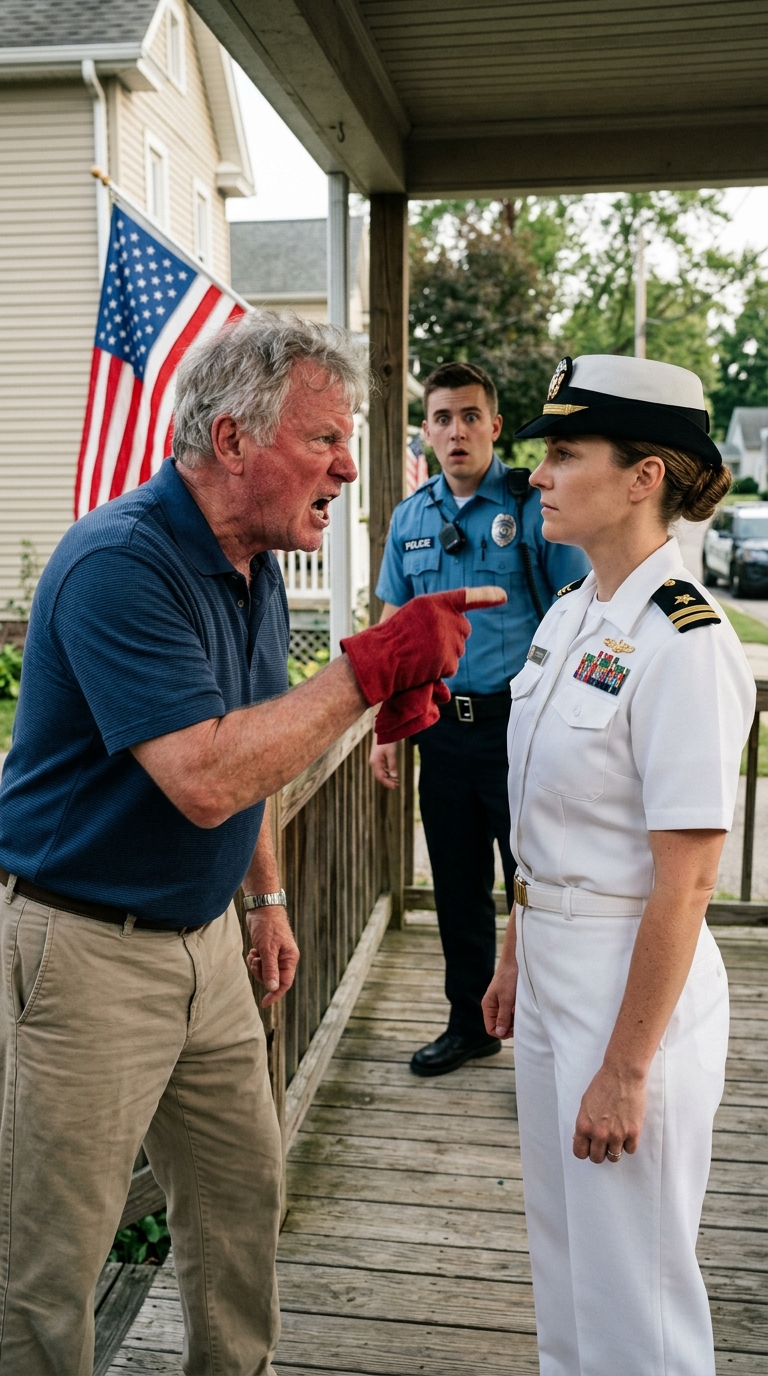
When I skidded to a stop in front of my house, the scene was a suburban nightmare. Flashing red and blue lights bathed the lawn. Neighbors were peeking through blinds. And there, standing on my grass, was my father. He was gesturing wildly to two officers, playing the role of the distraught, distinguished headmaster dealing with a delinquent child.