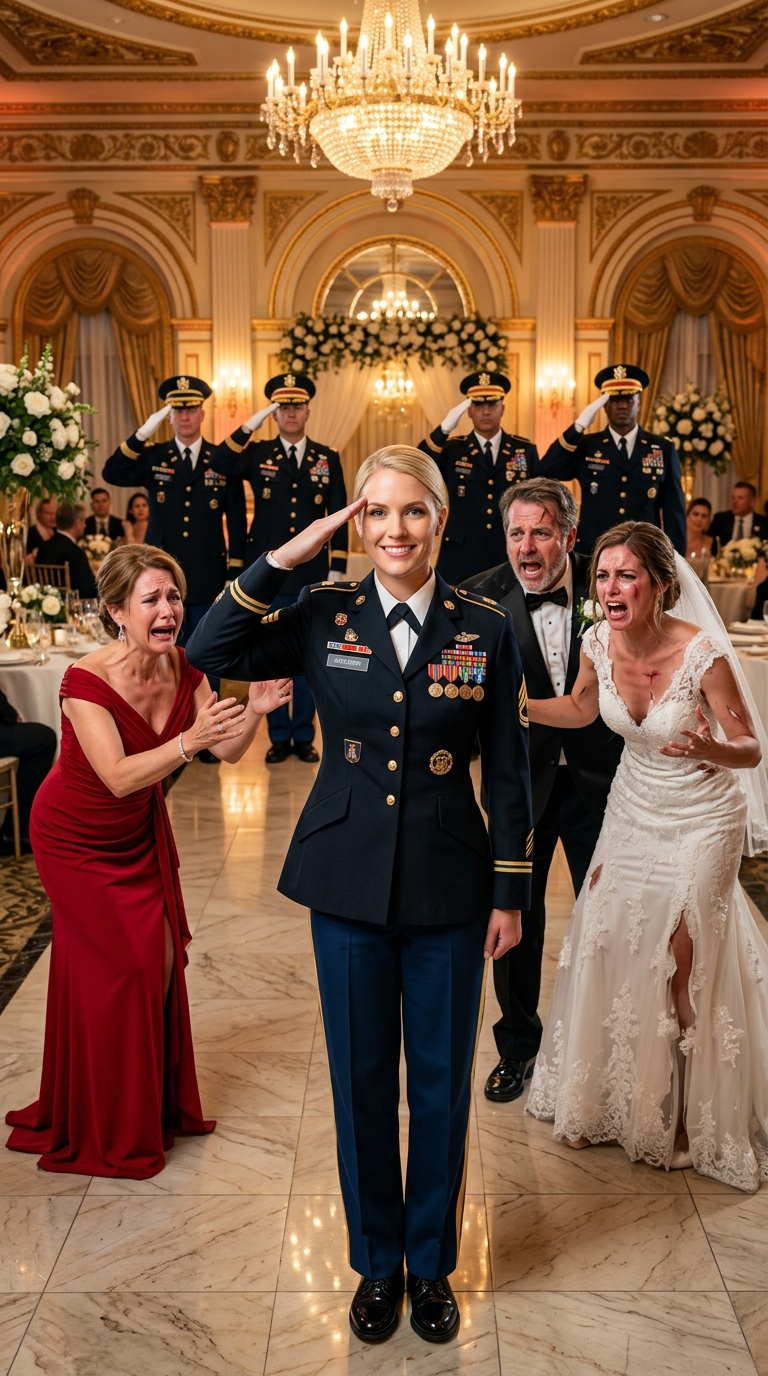
My mother, Eleanor Hayes, had always possessed a profound, almost terrifying love for an audience.
That was the absolute first thing I noticed when I stepped through the heavy, mahogany double doors of the reception hall. It wasn’t the overpowering scent of the imported white roses cascading from the ceiling, nor the glittering crystal chandeliers that refracted light like scattered diamonds. It wasn’t the obscenely expensive silk draped meticulously across the walls of the historic Richmond country club.
It was the audience. And she was holding court.
My mother was already standing dead center in the room, effortlessly collecting attention with that polished, rigid posture she deployed whenever she wanted to remind the room exactly who mattered and, more importantly, who did not.
She was a masterclass in passive-aggressive elegance, wearing a smile that never quite reached her eyes.
I should have known she wouldn’t waste the opportunity of a captive crowd.
My younger sister, Chloe, was getting married. The entire venue was a carefully curated exhibition of wealth, designed to look effortless while costing a fortune. It made perfect sense. My parents had spent my entire life treating money not as a utility, but as a language of love. And they had always been exceptionally fluent when speaking to Chloe.
I had not seen any of them in nine years.
Nine years of profound, heavy silence. The only interruptions had been the occasional, distorted family rumor that filtered down to me through distant cousins, passive-aggressive social media tags I ignored, and finally, one stiff, formal wedding invitation printed on heavy cream cardstock with embossed gold lettering.
When the invitation arrived at my base housing, I almost threw it directly into the trash can. I held it over the rim for a long time.
In the end, I slipped it into the top drawer of my desk for a week. Then, I took it back out, laid it flat on the wood, and stared at it until I finally admitted the truth to myself.
I didn’t want to go to celebrate. I wanted to know whether time had changed them. I wanted to know whether distance and age had softened the sharp edges of their judgment. But mostly, I wanted to know whether the things they used to say when I was young, broke, and powerless would still come out of their mouths now that I was none of those things.
The answer arrived within three minutes of my boots hitting the polished marble floor of the ballroom.
The room was buzzing with the low hum of expensive champagne and polite conversation. I walked in, wearing my Army dress blues.
I hadn’t come in civilian clothes; I wore the uniform because it was the armor I had built for myself when they refused to give me any. The brass buttons gleamed, the fabric was perfectly tailored, and the ribbons on my chest spoke of places and situations these people couldn’t even point to on a map.
The crowd parted slightly as I walked, turning their heads. My mother felt the shift in attention before she saw me. She turned, a perfectly rehearsed smile ready on her lips, but it froze the second her eyes locked onto mine.
She let her gaze travel from the polished tips of my shoes, up the dark blue trousers, across the medals pinned precisely to my chest, and finally to my face. Her expression twisted into a mask of theatrical disgust.
“Sarah,” she said, her voice carrying that sharp, aristocratic clip designed to pierce through background noise. “What is a lowly soldier like you doing back here ruining the aesthetic?”
She said it loud. Loud enough for half the surrounding tables to hear.
A few people in her immediate orbit gave that thin, reflexive laugh people always give when cruelty comes wrapped in the certainty of wealth. It’s the laugh of cowards who don’t want to be the next target.
My father, Richard, stood beside her. He didn’t defend me. He simply lowered his gaze into his scotch glass, taking a slow sip, playing the role of the silent enabler he had perfected over three decades.
Chloe froze beside the towering, five-tier wedding cake. The radiant smile on her face tightened instantly, looking like silk pulled too far, right before it tears. She looked beautiful, expensive, and entirely panicked.
And then, there was the groom.
I hadn’t met him yet. I didn’t know his face. But the man standing next to Chloe went so pale, so quickly, that for one impossible second I thought he might actually be having a medical emergency.
He was not looking at my mother. He was not looking at Chloe.
He was looking directly at me. His eyes were wide, fixed on my face, then darting to the name tag pinned above my right breast pocket: BENNETT.
He took a sharp, jagged breath, as if he had just been punched in the stomach. He shoved his heavy wooden chair back so hard it screeched against the marble floor, the sound cutting through the polite chatter like a gunshot.
He stood up, his fists clenched at his sides, and barked, “Enough.”
The room went dead still. The string quartet stopped playing in the middle of a phrase.
My mother drew herself up, deeply offended by the idea that anyone, even the groom, would interrupt her performance. She plastered on a condescending smile. “Liam, really, darling. She’s my older daughter. She’s always loved making dramatic, inappropriate entrances. Let’s not let her ruin your night.”
Liam ignored her completely. He took a step toward me, his eyes never leaving my face.
“Do you even know who she is?” Liam demanded, his voice shaking with a dangerous, barely suppressed fury.
My mother scoffed, waving a dismissive hand. “Of course I know who she is. She’s the daughter who ran away to play in the mud because she couldn’t handle real responsibility.”