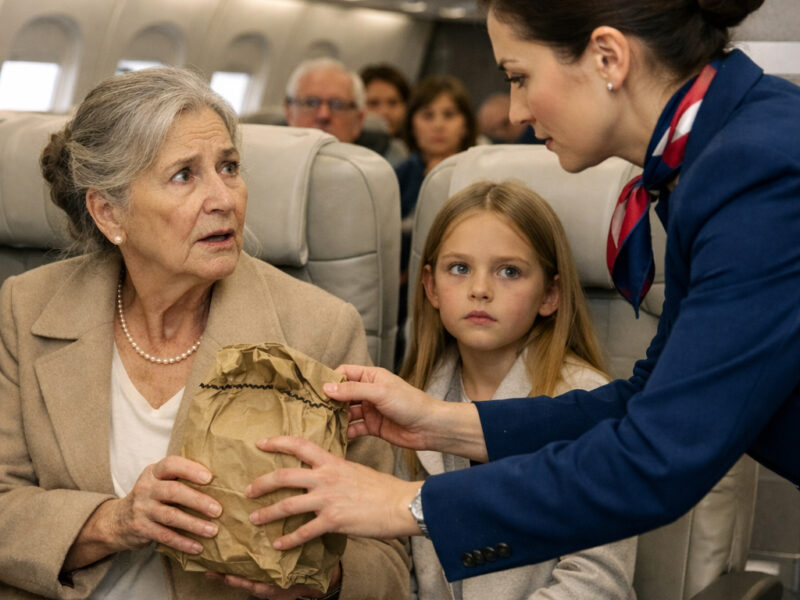
The flight attendant snatched my insulated bag out of my hands — I am seventy-three years old — before throwing my meal in the trash, in first class, under the silent gaze of my granddaughter. In that moment, I thought the most painful thing would be swallowing that humiliation, seated in 1A. But everything shifted when the child beside me whispered, “Grandma… Mom says not to tell her who you are just yet.”
At that exact moment, the flight no longer belonged to the crew.
My name is Eleanor Brooks. At my age, I thought I had lived enough to recognize humiliation before it reached deep inside me. I was wrong.
Some humiliations strike with such brutality, in broad daylight, that they no longer even feel like moments. They make you feel erased, while you remain seated, upright, in your place.
That morning, I boarded flight 1147 with my granddaughter, Ava Brooks, nine years old — a child far more perceptive than many adults I know. We were traveling first class, from Atlanta to Los Angeles, for a family gathering. As always when I fly, I was carefully dressed: a perfectly pressed lavender blouse, navy trousers, low-heeled shoes, and my pearl earrings — a gift from my husband for our thirty-fifth wedding anniversary.
I wasn’t trying to impress anyone. I was simply raised to believe that dignity begins with how one carries oneself, especially when the world gives you reasons to forget it.
Because of health issues and dietary restrictions tied to my religious beliefs, my daughter had prepared a small insulated meal bag for me the day before.
Nothing fancy. Just something safe to eat during the flight. It was neatly placed under the seat in front of me, next to Ava’s backpack and coloring book.
We were seated in 1A and 1B, and for the first few minutes, everything seemed normal.
Then the flight attendant arrived.
Her badge read Lauren Mitchell. The moment she looked at me, I felt that familiar chill some people hide behind a smile — the kind of look that lets you know they’ve already decided your worth.
She asked what was in my bag. I calmly explained that it was a necessary meal for medical reasons and in line with my religious dietary restrictions. I expected a simple check, maybe a procedural question.
But her tone changed.
She spoke to me as if I were trying to bring something unacceptable into her own living room. Her voice hardened. She said outside food was “not appropriate in this cabin.”
I tried to explain again, gently. She didn’t even let me finish.
Before I could hold onto it, she snatched the bag from my hands.