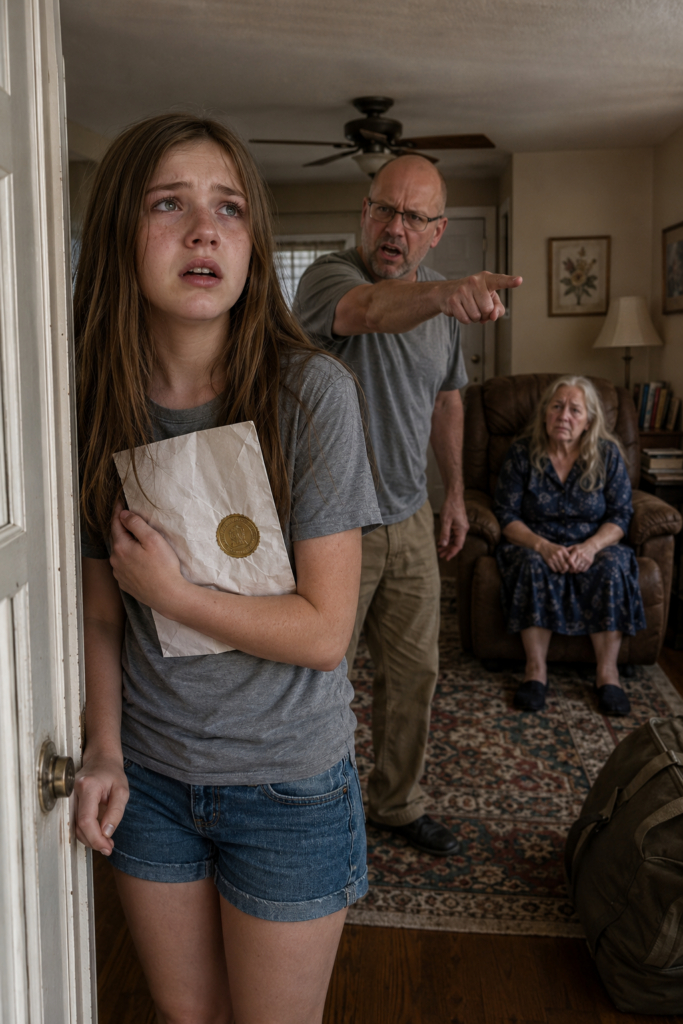
I thought I’d misheard. “A job?”
“Yeah,” he said. “Part-time, for now. You learn the basics. How to clean pieces without ruining them. How to spot a fake hallmark. How to tell if someone’s offering you a steal or a scam. In return, you let me broker the sale of some of these. Family discount on the commission.”
I stared at him, heartbeat roaring in my ears.
“Why would you do that?” I asked, suspicion and hope tangling together.
“Because Sophia saved my butt more times than I can count,” he said matter-of-factly. “Because if I don’t pass this knowledge on, it dies with me, and that’s a waste.
And because I can tell when someone is dying to learn and too proud to ask.”
The last sentence hit me right between the ribs.
“I… I want to learn,” I said. “I want to know everything.”
He snorted. “Careful what you wish for, kid.” Then he straightened and stuck out his hand. “Name’s Marco. Welcome to the business.”
I took his hand, my fingers dwarfed by his, and shook.
That was the day my life broke cleanly into Before and After.
The years that followed blurred into a kind of fever dream—hard work and harder lessons, the exhilarating rush of small victories. By day, I stocked shelves, cleaned cases, and mopped floors at Rain City. By night, I worked on my portfolio and finished high school online, my laptop propped on a milk crate in my rented room.
Marco was not an easy teacher. He didn’t praise often, and when he did, it was usually in passing, buried deep inside a criticism: “At least you didn’t polish that one to death.
Could’ve been worse.” But he opened the world to me, piece by piece.
He taught me how to look beyond shine and surface. How to read tiny hallmarks with a jeweler’s loupe—lion passant for sterling, maker’s marks that told stories of long-defunct workshops, date letters that pinned a piece to a particular year. How to tell silver-plated pretenders from solid pieces with a glance and the barest touch.
We attended estate sales where sorrow smelled like old perfume and stale cookies, and I learned to sift through boxes without flinching at the ghosts. I watched Marco negotiate with the delicate brutality of someone who respected the seller but respected the truth more.
“You’re not stealing from them,” he told me once, when he caught me hesitating over a price. “You’re paying them fairly for what they’re offering. The fact that you know what it’s really worth and they don’t? That’s not robbery. That’s the cost of expertise. Never forget that.”
Not all of the pieces from Sophia’s box went out into the world. I sold enough to build a starting fund, just like she’d intended, but I kept a few—things that called to me in a way I couldn’t quite explain. The simple gold locket with her photograph inside. The silver lily brooch. A ring with a tiny chip of emerald that reminded me of desert plants pushing through cracked asphalt.
At nineteen, I launched a modest online shop. I spent days photographing each piece in careful natural light, writing descriptions that were part story, part detective report. A Victorian mourning brooch with a lock of hair still preserved inside. A Deco bracelet that a flapper might have worn to some smoky jazz club in 1928. Marco helped me refine my price points and swore at me affectionately for undercharging.
“You’re not doing charity work,” he grumbled. “If they want a bargain bin, they can go to the thrift store. You’re selling history.”
Sales trickled in at first. A pair of earrings shipped to Chicago. A pendant to New York. With each transaction, my confidence grew. So did my obsession. I started waking up in the middle of the night with ideas for inventory sourcing, new markets, possible connections.
By twenty-three, I’d opened my first physical boutique in Capitol Hill, the rent as terrifying as the possibilities. The space was small but bright, the ceiling high enough to hang chandeliers that scattered light across gleaming silver. People stepped in out of the rain, shook out their umbrellas, and visibly relaxed in the soft glow.
I learned what they responded to: not just the price tags or the investment potential, but the way their shoulders unknotted when they put on a ring that felt like it had always belonged to them. I watched couples peer into glass cases as if searching for a piece of their own future. I saw lonely people find a strange, fierce comfort in holding something that had survived a century.
I reinvested every extra dollar. Another gallery in Portland, tucked into a neighborhood that smelled like coffee and ambition. A private showroom in San Francisco, appointment-only, where tech millionaires with uncertain eyes came to buy artifacts that anchored them to something older than code.
Rain City Antiques turned from my training ground into my first acquisition. Marco pretended to grumble about the paperwork but cried, very quietly, the day he handed me the keys.
“Don’t let it become one of those Instagram prop stores,” he muttered. “This place has teeth.”
“I won’t,” I promised. “I’ll keep the teeth.”
At twenty-six, I signed the documents that made me the owner—via a carefully structured holding company—of Rainier Tower. The building had weathered more market storms than I had birthdays. It had good bones and terrible management. I gave it both a facelift and a new operating philosophy, filling vacant floors with tenants I handpicked: small design firms, a co-working space for creative freelancers, a ceramics studio that made the lobby smell faintly of clay and kiln heat.
I kept the top floor for myself.
The day I moved into that office, with its wall of glass and its view of a city I’d rebuilt myself in, I felt something inside me settle. Not the part that still ached when I thought of Tucson, or of my father’s face the day he threw me out. Not the part that wondered, late at night, whether my mother ever opened her mouth in defense of herself when I wasn’t there.
But the part that had made a promise in a motel room years ago—to prove Sophia right and him wrong—that part finally exhaled.
I didn’t tell my family.
For a long time, our relationship existed in a kind of stilted limbo. My mother would call occasionally, conversations filled with the weather and her garden, carefully sidestepping anything that might ignite another explosion. Maria texted more often: quick updates about classes, the occasional photo of something she thought I’d like. I posted strategically ordinary pictures online—dingy laundromats, scratched café tables, generic cityscapes. Let them assume I was just getting by.
Let them underestimate me.
Then the email from Maria landed in my inbox like a stone dropped into a still pond.
I reread it, slowly, forcing my eyes not to skim.
Dad had apparently lost his job months before. A new manager, budget cuts, a restructuring that had no room for people his age and temperament. He’d tried to replace the lost income with “investments”—day trading, crypto, anything that promised high returns and quick satisfaction. It hadn’t gone well.
My mother, always careful to a fault, had finally gone to a doctor about the chest pains and fatigue she’d been ignoring for years. Tests had led to more tests. Medications. Procedures. A slow avalanche of bills that collected faster than they could pay them.
They’d taken out a second mortgage on the house. Then refinanced. Then, when the numbers still didn’t add up, they’d leaned on Maria’s rising income in real estate. She’d sunk money into a condo flip project in Capitol Hill that had seemed like a sure thing—until the market shifted under her feet.
Now, three different fuses had burned down to the same stick of dynamite: the house.
Foreclosure notices had started arriving. Maria’s email was written in the language of someone trying very hard not to panic.
I read it three times. I remembered my father’s voice: Don’t come crawling back when you fail.
And then I opened a different window on my computer, typed in a password, and logged into a system he didn’t know I had access to.
Cascadia Trust’s internal dashboard flickered to life. Years ago, I’d acquired a controlling stake in the regional lender after noticing how undervalued it was and how badly it needed competent leadership. I’d learned very early on that owning the money was almost as powerful as owning the land. My board thought I liked diversification. The truth was simpler: I liked leverage.
It took me less than a minute to pull up my parents’ file.
Three months behind on their mortgage. Late fees stacked like cordwood. A slow, inexorable march toward an auction date. Line items for my mother’s hospital visits, the insurance denials stamped in red. Notes about phone calls made and not returned.
I checked Maria’s condo loan next. The project was bleeding cash, the carrying costs eating her alive. She was one stalled sale away from default.
I stared at the numbers until they stopped looking like numbers and started looking like a story: a man too proud to change course, a woman too quiet to speak up, a daughter whose dreams had been diverted into something she’d never wanted.
In a separate account—one I rarely touched—I had more than enough to make the problems disappear.
I’d kept that reserve precisely for this scenario, even if I’d never admitted it to myself. All the tough talk, all the bitter internal speeches about how I didn’t need them, and yet here I was, more prepared for their eventual collapse than they had ever been for my departure.
The cursor on Maria’s email blinked, waiting.
I picked up my phone and hit call before I could overthink it.
She answered on the second ring. “Nadia?”
“Hey,” I said, hearing the steadiness in my own voice with a kind of detached fascination. “Got your email.”
“I… yeah. I’m sorry to dump it on you,” she said in a rush. “I know you’ve got your own stuff going on. I just… I didn’t know who else to ask. We’re kind of—”
“Drowning,” I finished for her. “I know.”
There was a pause. “You know?”
“I’m a majority shareholder in Cascadia Trust,” I said. “Your lender. I’ve seen the file.”
Dead silence.
“You… what?” she stammered.
“It’s a long story,” I said. “One I’ll tell you tomorrow.”
“Tomorrow?”
“I want you to bring Mom and Dad to my office,” I said. “We’ll talk there.”
“Your… office?” Suspicion crept into her voice. “Like, the consignment shop you used to help out at? Or that little gallery you opened?”
“My real office,” I said. “In Rainier Tower. I’ll text you the address.”
She laughed, the sound high and nervous. “Nadia, you can’t just stroll into Rainier Tower and pretend—”
“I’m not pretending,” I said, glancing around at the expanse of glass and polished wood and carefully curated antiques. “Trust me. They’ll let me in. Just be there at nine tomorrow morning. And Maria?”
“Yeah?”
“Tell Mom and Dad to bring every piece of paperwork they have on the house. All of it.”
“Okay,” she said slowly. “I’ll… I’ll try to get them to come. No promises. Dad’s been… weird.”
“When is he not,” I muttered, then softened my tone. “Just get them in the car. I’ll handle the rest.”
After we hung up, I sat for a long time in the dimming light, watching the city shift from muted gray to glittering points of gold. I thought about what I was about to do. The power I held. The weight of it.
In the corner of my desk, next to my laptop, sat Aunt Sophia’s old jewelry box. It was small, unassuming, the hinges slightly squeaky. I opened it and took out the simple gold locket—the one piece I’d never been able to sell.
Her photograph smiled up at me from behind the tiny oval of glass, eyes crinkling, head tilted in mid-laugh. On the back of the locket, engraved in minuscule letters, was the word worth.
“What would you do?” I asked the empty room.
The silence answered in memories.
Sophia, teaching me how to haggle at a flea market when I was ten, turning the negotiation into a game: Always know your bottom line before you start talking, kiddo.
Sophia, sending me a battered postcard that read, Sometimes the things you rescue are people, not objects. Don’t forget that.
I closed my eyes.
“Fine,” I said, not sure if I was talking to her or to myself. “I’ll do this. But I’m doing it my way.”
The next morning, I arrived at the office earlier than usual. The air was crisp, clouds moving fast overhead, the sidewalks still damp from a pre-dawn drizzle. The lobby of Rainier Tower gleamed with polished stone and brushed steel, the security desk staffed by a guard who nodded at me with the deference reserved for those whose names were printed on internal memos.
Upstairs, my assistant Jasmine had already turned on the lights. The double doors to my office stood open, revealing the space I’d spent months designing.
It wasn’t a typical corporate office. I’d never wanted one of those sterile boxes with gray carpet and soulless art. The floors were dark walnut, warm and smooth underfoot. One wall was entirely glass, the skyline framed like a living photograph. The other walls were adorned with carefully chosen pieces: an Art Nouveau mirror whose frame curled like vines, a mid-century painting of a woman with a secret in her eyes.
In glass cases along one wall, some of my favorite acquisitions rested under soft light: a silver tea set from 1905, its surface chased with delicate flowers; a Deco cigarette case that had once belonged to a jazz singer; a brooch shaped like a thundercloud with dangling raindrop pearls.
Behind my desk—a custom-designed rosewood piece that had once sat in a Rockefeller estate office—I’d placed a piece of modern glass art by Chihuly, its twisting forms catching and fracturing the light into watery colors.
This office was more than a workspace. It was a thesis, a manifesto: I am here. I built this. I will not apologize.
Sometime around eight-thirty, my phone buzzed with a text from Maria: We’re downstairs. Security says we’re on a list??
I smiled despite myself and buzzed Jasmine.
“They’re here,” I said. “You can send them up in ten.”
“Got it,” she replied. “Want coffee?”
“Yes,” I said. “Chamomile tea for later, too.”
My father had always insisted that success meant dominating a room—talking the loudest, making the most dramatic entrance, the world bending around your presence. I’d learned another way: let the room do the talking.
At exactly nine, the intercom chimed softly.
“Your family is here, Nadia,” Jasmine said. “Shall I bring them in?”
“Yes,” I said, standing. “Send them in.”
I moved to stand near the windows, hands clasped loosely behind my back, facing the door. It felt, for a surreal second, like a theater performance. The stage was set. The actors were in their places. The audience was about to realize the script had changed.
The door opened.
My father stepped in first.
Time had not been kind to him. Or perhaps, more accurately, he had not been kind to time. His hair, once thick and dark, had thinned to salt-and-pepper strands, combed stubbornly forward. The lines around his mouth had deepened, carved deeper by years of frowning. He wore a button-down shirt and slacks that had probably fit better fifteen pounds ago.
His eyes swept the room in a rapid, jerky motion—taking in the height of the ceiling, the expansiveness of the windows, the glint of silver in the cases. Something like disorientation flickered across his face.
My mother hovered just behind him, fingers pressed white-knuckled around the strap of her purse. Her hair, once long and dark, was shot through with gray, pulled back in a simple clip. She looked like she’d shrunk around her bones, as if stress had carved pieces out of her.
Maria brought up the rear, eyes wide, mouth slightly open, clutching a leather portfolio to her chest like a shield.
They all stopped two steps inside the room, frozen as if someone had pressed pause.
“Nadia,” my mother breathed. “This… this is where you work?”
I turned slowly, giving them time to take in the view behind me: downtown stretching toward the water, the Space Needle a white punctuation mark in the distance.
“Welcome to my office,” I said. “This is Russo Fine Art and Antiquities headquarters.”
My father blinked. “You… you work here?” he asked, his voice carrying the same note of disbelief it had when I’d announced my RISD acceptance all those years ago. “What, as a receptionist? Assistant?”
I moved toward my desk, resting my hand on the polished wood. “No,” I said. “As the owner. I founded the company. I run it.”
He laughed then, a sound so harsh and automatic that it bounced strangely against the glass.
“Come on,” he scoffed. “Don’t start with your stories. You expect me to believe—”
“I own the firm,” I said, more firmly this time. “And the firm owns this building.”
Maria made a choking sound. “You—what?”
“I bought Rainier Tower last year,” I said. “Through a holding company. It was undervalued and mismanaged. I saw an opportunity.”
I walked around the desk and picked up the leather-bound folder I’d prepared the night before, sliding it across the glossy surface toward them. My father stared at it as if it might bite him.
“I wanted to show you something,” I said. I opened my laptop and turned the screen slowly so it faced them. “This is my current account balance.”
Eight digits stared back up at them, unblinking.
My mother gasped, one hand flying to her chest. Maria murmured something that sounded like a prayer. My father’s eyes darted back and forth between the number on the screen and my face, as if waiting for someone to shout that it was a joke.
“This is some trick,” he said, but the conviction was gone from his voice. “You’re showing me… I don’t know, company money. Not yours.”
“That’s just one of my personal accounts,” I said. “The business has separate finances. I don’t commingle.”
He flinched, the unfamiliar vocabulary hitting him like a physical shove.
For a long moment, no one spoke. The only sounds were the distant city hum and my mother’s uneven breathing.
Finally, Maria found her voice.
“You’ve been… living like this,” she said slowly, gesturing around the office, “while we thought you were… scraping by?”
“Yes,” I said.
“Why?” she asked, incredulous. “Why wouldn’t you tell us?”
There it was. The question I’d been bracing for.
“Because the last time I told this family about a dream,” I said evenly, “I was told to pack my bags and get out. Because every time I tried to talk about my work after that, I was mocked or dismissed or told to get a ‘real’ job. Because it was easier to let you believe I was small than to argue about my right to be big.”
My father opened his mouth, then closed it again. It was like watching an old machine misfire.
“We didn’t mean—” my mother began automatically, but I cut her off with a tiny shake of my head.
“You may not have meant to,” I said, “but you did.”
I reached for the second folder and opened it, flipping to the first page. “Now. Let’s talk about why I asked you to bring your mortgage paperwork.”
Maria shifted the portfolio in her arms and finally stepped forward, laying it on my desk. Her fingers trembled as she unzipped it and pulled out a sheaf of documents—statements, payment schedules, letters stamped with increasingly urgent red ink.
I laid my own printouts beside theirs: internal reports from Cascadia Trust, foreclosure notices they hadn’t yet received, projections.
“This,” I said, tapping the stack, “is where you are. You’re three months delinquent on your mortgage. Foreclosure proceedings have started. You have six weeks until the house is scheduled for auction.”
My mother made a strangled sound. My father paled.
“That’s not possible,” he snapped. “They said—”
“They said all kinds of things,” I said. “But what the system says is what matters. You are about to lose the house.”
Maria swallowed. “And my condo project?”
I slid another report into view. “It’s on life support. One more late payment and they’ll call the loan. You’ll owe the balance immediately. You don’t have it.”
“How do you know all this?” she whispered, even though I’d already told her.
“I own a controlling interest in Cascadia Trust,” I said. “Your lender. I can see everything.”
My father’s jaw clenched. “So you’ve been spying on us,” he snapped. “Watching us drown and doing nothing?”
“I’ve been watching,” I said. “Yes. Because whether you admit it or not, your choices still affect me. I wanted to know when the crash was coming.”
He bristled, drawing himself up instinctively. “We made some bad investments,” he said stiffly. “Who hasn’t? The market is unpredictable. The doctors overcharge. None of this is—”
“Your fault?” I finished. “No. Of course not. It never is.”
He glared at me. “Don’t talk to me like I’m some child.”
“Then stop acting like one,” I said, the sharpness in my voice surprising even me.
Silence crashed over us.
I stood slowly, placing my hands flat on the desk. “Here’s the reality,” I said. “The total amount of your mortgage, the late fees, the condo loan, and Mom’s medical debts comes to about 2.4 million dollars. That’s the number that will wipe the slate clean.”
My mother closed her eyes as if the number itself hurt. Maria’s lips moved silently, repeating it to herself like a curse.
“I have that,” I continued. “Wrapped up in a reserve fund. I’ve had it for a while. Every time a notice went out, every time you teetered closer to the edge, I considered stepping in.”
“But you didn’t,” my father said bitterly.
“I didn’t,” I agreed. “Because I wanted to see if anyone would change. If you would stop making the same decisions that got you here. If you would take responsibility.”
I looked at each of them in turn.
“You didn’t,” I said quietly. “You borrowed more. You doubled down. You took on extra risk instead of cutting back. You counted on luck, not discipline.”
My father opened his mouth, then shut it again. My mother stared at her hands in her lap, as if they belonged to someone else.
“So what now?” Maria whispered. “Is this just… you rubbing it in? Showing us what you could do but won’t?”
“No,” I said. “If I wanted to hurt you, I’d let the foreclosure go through and buy the house at auction. It would be cheap. I’d own the place that used to own me. That’s not what I’m doing.”
I took a breath that felt like it came from the soles of my feet.
“I’m going to pay it all,” I said. “The debt. The late fees. The medical bills. The condo loan. I’m going to use my money, and my position, to pull all of you back from the edge.”