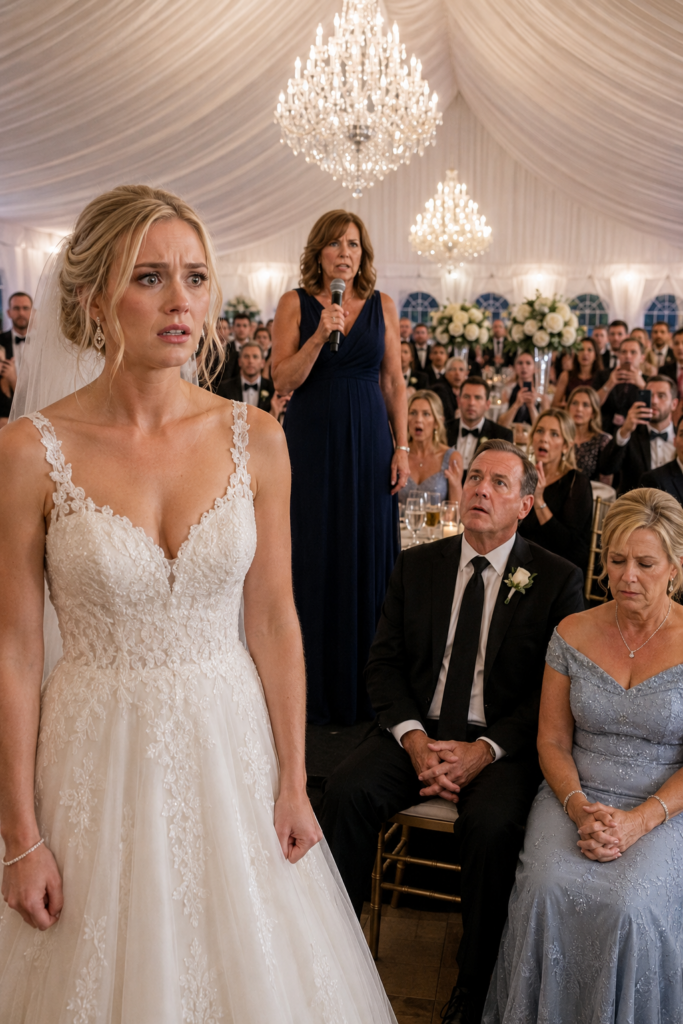
“Answer the question,” Daniel said. “Did you know they did it while she was in surgery?”
Tears spilled down Megan’s cheeks. “Daniel, please,” she whispered. “This is our wedding.”
He looked around the room—the centerpieces, the chandeliers, the cameras capturing every angle.
“What I see,” he said quietly, “is a celebration built on theft. And lies.”
My mother sank back into her chair. My father stood rigid, fists clenched, scanning the room like he could still somehow control the narrative if he just found the right audience.
I lifted the microphone one last time.
“I want to be clear,” I said. “I didn’t bring this up to ruin a wedding. I’m not the one who chose this timing. They are. They chose to do what they did when they did it. I chose to stop keeping their secrets.”
I looked at Megan. Her mascara had begun to streak. She looked like a painting left in the rain.
“For what it’s worth,” I said softly enough that only the front tables could really hear, “I hope one day you learn what love looks like when it isn’t measured in price tags.”
I set the microphone on the table with deliberate care. The feedback squealed briefly, then cut off.
Then I turned and walked off the platform.
No one tried to stop me. The crowd parted as I moved through it, some looking away, some staring openly, some lifting their phones to film me like I was part of the spectacle instead of the one who’d just ended it.
Outside, the air felt different. Cooler. Cleaner.
I found a bench in the hotel garden and sat down slowly. The fountains burbled. Somewhere, beyond the tent, the string quartet stuttered back into a tentative tune, the people in charge trying desperately to stitch together a semblance of normal.
Patricia joined me, sitting without a word. For a while, we just watched the late afternoon light slant through the trees.
“How do you feel?” she asked eventually.
“Tired,” I said honestly. “Mostly tired.”
After a while, guests began to trickle out of the tent in twos and threes. Some avoided my bench completely. Some shot me quick glances filled with a whole mosaic of emotions—anger, sympathy, curiosity.
Cousin David, who had urged me to “apologize for the family’s sake,” stopped a few feet away, hands in his pockets.
“Holly,” he said. “I… I’m sorry. I should’ve asked what really happened.”
I looked up at him. “You did what everyone does,” I said. “You believed the story that cost you the least to believe.”
He flinched.
Great-aunt Margaret marched straight over, her sensible shoes crunching on the gravel. She grabbed my hand with surprising strength.
“I always said your father didn’t deserve you,” she declared. “Your grandmother would be proud of you, girl.”
That one made my throat tighten.
The person who surprised me most, though, was Daniel’s mother.
She approached with measured steps, her designer heels sinking only slightly into the grass. Her face was composed.
“May I sit?” she asked.
I nodded, and she lowered herself next to me, folding her hands neatly in her lap.
“I want you to know,” she said, “that we had no idea about any of this. If we had, this wedding would never have happened.”
“I know,” I said. “This isn’t on you.”
“Daniel is devastated,” she went on, looking out at the garden. “He’s in a room with Megan and her parents right now, trying to make sense of everything. I told him he doesn’t have to make any decisions tonight. But…” She sighed. “He’s not a fool.”
“I’m sorry,” I said. And I meant it. Whatever else I felt, I didn’t relish watching someone’s life explode.
She studied my profile for a moment. “You didn’t do this to hurt him,” she said. “You did it because you were hurt.”
“I did it because they’ve been rewriting my life my entire life,” I said. “This is the first time I’ve grabbed the pen.”
A small huff of air escaped her, almost a laugh.
“For what it’s worth,” she said, standing, “I think you did the right thing. A marriage built on deception was never going to survive. Better that the truth comes out now than ten years from now.”
She walked away without waiting for my response.
I sat there as the sun slid lower and the shadows lengthened. My back ached. Every muscle in my body felt like it had been wrung out. But under all that, there was a strange, quiet calm.
An hour later, Daniel found me.
His bow tie was hanging loose around his neck. His hair, which had been meticulously styled earlier, was mussed like he’d dragged his hands through it a hundred times. His eyes were red-rimmed.
“Can I sit?” he asked.
“Yes.”
He dropped onto the bench beside me, elbows on his knees, hands dangling.
“I’m sorry,” I said again. It felt inadequate and also like the only thing there was to say.
“You have nothing to be sorry for,” he said hoarsely. “You might have just saved me.”
He stared straight ahead for a long moment.
“Three months ago,” he said, “my laptop disappeared from Megan’s apartment. I thought I’d left it at home. Then I remembered carrying it in. She said maybe her building had been broken into. But nothing else was missing. Just the laptop.”
A cold little knot formed in my stomach.
“I didn’t think too much of it,” he went on. “I work in finance. We keep backups. I was annoyed, mostly. But today, after what you said, I went back over a few things in my mind. Little coincidences that felt… less like coincidences.”
“My financial records were on that laptop,” he said. “Details about my family’s holdings. Trusts. Investments. The kind of information that would make it very clear exactly what someone could gain by marrying me.”
He finally turned his head and looked at me.
“I don’t think I was just some guy she fell in love with,” he said. “I think I was a project. A target.”
I didn’t say anything. There didn’t seem to be anything useful to say.
“I talked to my parents’ lawyer,” he said. “We’re filing for an annulment. Fraud. Misrepresentation. The whole nine yards.”
Something inside me loosened just a little. Not out of malice—though I’d be lying if I said there wasn’t part of me that felt Megan finally facing a consequence—but out of a sense that the universe, for once, was tilting in the direction of fairness.
“What are you going to do?” I asked.
He laughed without humor. “Try to figure out who I am when I’m not being played,” he said. “Might take a while.”
He stood, then hesitated.
“I know it cost you a lot to tell the truth today,” he said. “If you ever need a reference for your… character,” he added, and there was a wry twist to his lips, “call me.”
After he left, the garden emptied. Staff began quietly dismantling the fairy tale—folding chairs, blowing out candles, stacking plates. By the time I called a cab, the reception tent looked like a ghost of itself.
The official fallout came quickly.
Someone had recorded my speech and uploaded it. First to a family group chat, then to a private Facebook group, then—inevitably—beyond. I watched, almost detached, as the view count went up. As strangers with no stake in my life weighed in with opinions that, weirdly, hurt less than my own relatives’ silence had.
My father’s company called him in for a meeting about “ethical concerns.” They couldn’t ignore the circulating video of him acknowledging a “family contribution” that turned out to be stolen from his own daughter.
He’d spent thirty-two years there. It took them less than two weeks to put him on indefinite unpaid leave.
My mother’s social circles evaporated. The tennis group stopped inviting her. The charity board she’d chaired for years politely asked her to step down “until things settled.” Women she’d gossiped with for over a decade suddenly had “other commitments.”
Megan’s influencer career—which, on inspection, had always been more smoke than fire—took a nosedive. The story of the wedding made its way to Reddit, embellished in places but essentially accurate. People found her Instagram and flooded the comments.
“Imagine stealing from your own sister.”
“This is sick. I hope she never sees a sponsorship again.”
“Girl, this isn’t just ‘drama.’ It’s criminal.”
Her real followers dwindled. The bots remained, faithfully liking every post. They were, I thought, the perfect audience for her: present, uncritical, and incapable of holding anyone accountable.
Daniel’s annulment went through faster than I’d thought possible. Money could buy speed, if not always justice. Within weeks, Megan was unmarried and living back with my parents in the house they didn’t realize was mine.
And then the eviction notice was delivered.
Thirty days, by law.
My father called two hours later.
“Holly,” he said. His voice sounded thinner. The booming confidence had drained out, leaving something papery and brittle. “What is this?”
“It’s a notice,” I said. “You have thirty days to vacate the property.”
“You can’t do this,” he said. “We’ve lived here twenty years. This is our home.”
“It’s my home,” I said. “I bought it to save you from foreclosure, remember?”
“You’re going to make us homeless,” he said. “Your own parents. What kind of person does that?”
“The kind of person whose parents stole four hundred twenty-five thousand dollars from her while she was unconscious,” I said. “The kind of person whose parents never once asked how she was healing after major surgery, because they were too busy planning a party.”
“We made a mistake,” he said, and I could hear the strain as he tried to shape it into something smaller, something forgivable. “We got carried away. We thought—”
“You thought I would just take it,” I said. “Like I always have. You thought I’d swallow the anger and help you out again. Like I always have.”
Silence.
“Please,” he said finally. The word sounded unfamiliar in his mouth. “Just give us a little more time. A few months. We’ll figure something out. You’re punishing us. You’re destroying the family.”
“I’m not destroying anything,” I said. “I’m just refusing to be destroyed with you.”
“If you do this,” he said, and now the anger was back, but it was weaker, like a fire about to go out, “you are no longer my daughter.”
“That’s the first honest thing you’ve said to me in a long time,” I said.
I hung up before he could answer.
In the quiet that followed, I realized my hands were steady. My heart was steady. For once, my body wasn’t betraying me with shaking and nausea after a confrontation. I’d drawn a line and stayed on my side.
Thirty days later, I walked through the empty house with Patricia beside me.
The rooms echoed. The familiar furniture indentations on the carpet looked like ghost outlines of a past life. The kitchen smelled like cleaning chemicals. Rooms that had once seemed cramped with arguments and slammed doors now felt oddly cavernous.
In the living room, I could still see it as it had been when I was eight—Christmas tree in the corner, twinkling lights reflecting in the window, Megan tearing through wrapping paper like a tornado while I sat on the floor carefully peeling tape from my own presents so I could reuse it.
Patricia watched my face.
“Any regrets?” she asked quietly.
“A few,” I said. “But not about this.”
“What are you going to do with it?”
“I found tenants,” I said. “A couple in their late twenties. Both teachers. Been priced out of everywhere else nearby. They were almost in tears when they saw the place.”
“And the rent?” she asked.
“It’s going into a fund,” I said. “For a program that helps women dealing with financial abuse from family members. Loans in their names. Secret credit cards. That sort of thing. Marcus put me in touch with a group that needs support.”
She smiled, the kind of smile that made her eyes crinkle in a way that reminded me faintly of the nurse in the recovery room.
“That’s very you,” she said. “Find a way to make something ugly into something that helps someone.”
We walked through each room one last time. The bedroom where I’d cried myself to sleep as a teenager after being told I was “too much.” The hallway where Dad had told me I wasn’t pretty, but it was okay because I was smart. The kitchen where Mom had once suggested Megan shouldn’t bring her fiancé over too often because “Holly’s place is… small.”
When we left, I locked the front door and slid the key into my pocket.
Three months after the wedding, I saw my mother again.
I was walking through a small park near my new apartment—a slightly cramped but cozy place I’d rented while I figured out my next move. The mortgage-free life I’d carefully built in that condo was gone, but my job was still mine. My skills were still mine. My spine was slowly, stubbornly, healing.
The air smelled like cut grass and distant food trucks. Children shouted somewhere near the swings.
I spotted her on a bench near the fountain. She sat with her shoulders rounded, hands folded around a cheap-looking handbag that wasn’t her usual style. Her hair, which she’d always dyed a glossy chestnut, showed streaks of gray at the roots.
For a moment, I considered walking past. Pretending I hadn’t seen her. Preserving the clean cut.
Instead, I found myself crossing the path.
“Hi,” I said.
She looked up. Her eyes widened, then shuttered. “Holly,” she said. She sounded tired.
“Can I sit?” I asked.
She shrugged, which I took as a yes.
We sat there, a polite distance between us, listening to the splash of the fountain.
“How are you?” I asked eventually.
She snorted softly. “Oh, you know,” she said. “Your father’s depressed. Megan can’t find work outside that store. People whisper when I walk into the grocery store. Life is just fantastic.”
Guilt tried to poke its head up. I stepped on it.
“I didn’t tell them to whisper,” I said.
“No,” she said. “You just told the entire world that we’re monsters.”
“You sold my home,” I said. “You forged my name. You spread a story about me trying to ruin the wedding before I said a word. I just… disproved it.”
She flinched. For a moment, I thought she might actually apologize. A real one, not the half-hearted, self-pitying kind she’d given when my childhood hamster had died because she’d forgotten to feed it.
“I never meant for it to go that far,” she said softly. “We just… we were under so much pressure. Megan wanted… and Daniel’s family expected… and we thought…” She trailed off. “You have always been so strong. I thought you could handle it.”
“I handled it,” I said. “Just not in the way you expected.”
She turned to look at me properly then, as if seeing me clearly for the first time in years. There were lines at the corners of her mouth I didn’t remember. The gloss of superiority had cracked.
“You were always the strong one,” she said. “I used to tell your father that. ‘Holly will be fine. She doesn’t need us the way Megan does.’ I thought I was complimenting you.”
“You were excusing yourselves,” I said.
Her mouth trembled. She blinked rapidly, then looked away.
“I wish…” she started, and stopped. Her hand clenched around her handbag strap. “I wish I knew how to fix this,” she said finally.
“That’s not my job,” I said.
She nodded slowly, as if she’d expected that. We sat in silence a little longer.
“You should go home,” I said at last. “It’s getting cold.”
She stood, hesitated, then put a hand out as if she might touch my shoulder. At the last second, she let it drop.
“Take care of yourself,” she said.
“You too.”
She walked away, her figure shrinking until a group of kids on bikes passed between us and she vanished from view.
I sat there until the sky turned pink, letting the ache in my back anchor me to my body, to the present. It made a distant kind of sense that the physical pain was healing faster than the emotional sort. Bones can knit. Nerves can reroute. But the absence of something that should’ve been there—love, respect, safety—leaves a shape no surgery can fix.
Two years later, I turned thirty-four.
I signed papers on a modest townhouse on the edge of the city. Smaller than the condo. Less glamorous. But when I stood in the empty living room on the first night, listening to the hum of the refrigerator and the distant traffic, I felt something I hadn’t felt in a long time.
Peace.
No one had helped me buy it. No one had contributed “family money.” The down payment was mine. The mortgage was mine. The chipped paint on the banister would be mine to fix, too.
I unpacked slowly over the next week. A box of books here. A mug there. A worn blanket draped over the back of a thrift-store couch. The cane leaned in the corner of my bedroom closet, a relic of a past version of me—both a reminder of what I’d survived and proof that I could heal.
Sometimes, late at night, I’d sit on my small back step with a cup of tea, watching the neighbor’s cat stalk through the alley. I’d pull my phone out and scroll through messages from strangers who’d seen my story online and written to say, “This happened to me too.”
People whose families had opened credit cards in their names. Who’d drained college funds to pay for vacations. Who’d guilted them into co-signing loans they later defaulted on.
“I thought I was alone,” one woman wrote. “Your story made me feel less crazy. Thank you.”
I saved that one.
What I learned, standing in that hospital bed listening to my father’s voicemail, what I’d relearned at the wedding with a microphone in my hand, and then again every day since, was this:
Saying no isn’t cruelty.
Walking away isn’t betrayal.
Refusing to be used isn’t selfish.
Sometimes the most radical, loving thing you can do—for yourself—is to admit that blood is not a blank check.
I used to think that if I worked hard enough, if I achieved enough, if I gave enough, my parents would eventually turn toward me and see me as something other than the “smart one” whose job it was to fix their mistakes.
They never did.
So I turned toward myself.
I bought myself a home. Twice. I rebuilt my career after weeks that blurred into months of recovery. I invested my money in charities and people who would never try to steal my future while I lay unconscious.
I stopped setting myself on fire to keep other people warm.
Sometimes, when I pass a bridal shop and see a girl in a white dress staring at herself in the mirror, I feel a pang—not of envy, but of an odd kind of hope. I hope she’s walking into something built on truth. I hope she has people in her life who would rather shrink the guest list than steal her sister’s home. I hope, if she doesn’t, that she has the strength to pick up a microphone someday and tell her own story anyway.
Because that’s the thing about stories. The ones we’re handed can cage us. The ones we tell ourselves can set us free.
And if there’s one thing I know now, it’s this: I deserve to be free.
THE END
✅ End of story — Part 3 of 3
← Read from Part 1